Request for Proposals: Upstate Forever seeks consultant for GIS mapping and modeling services. Apply by 5:00 p.m. ET on November 6, 2026. Learn more



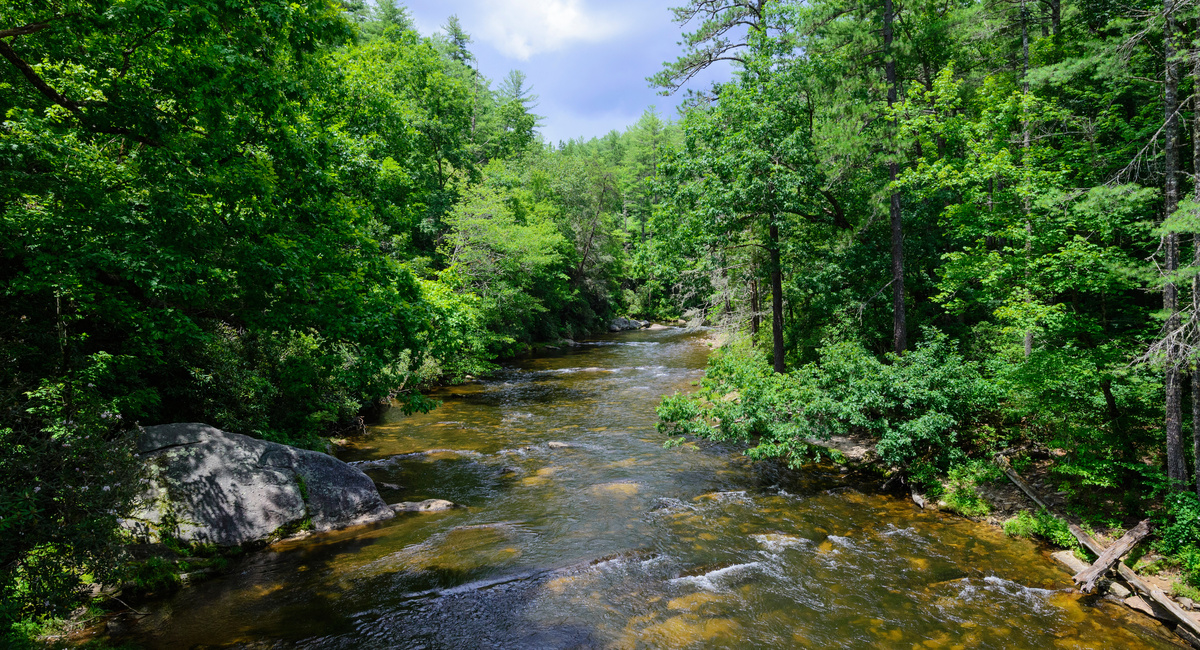
Chattooga: Jewel of the Southeast
Famous for its role as the backdrop of the 1972 film "Deliverance," the spectacular Chattooga River remains the only National Wild and Scenic River in South Carolina.
The Chattooga River is an ancient, majestic force that bends and weaves around primeval granite formations for almost 42 miles along the uppermost corner of the Upstate.
With headwaters beginning in creeks and streams of the Southern Appalachian Mountains in North Carolina, the Chattooga descends suddenly from an elevation of 3,360 feet to an elevation of 2,469 feet until it hits the Tugaloo Lake between Georgia and South Carolina. That’s almost a half-mile fall in elevation.
The river’s sharp drop makes it one of the best whitewater recreational rivers in the eastern United States and showcases the 4,800-foot granite monolith on the Blue Ridge Escarpment.
This famous abrupt drop also creates a unique ecosystem found nowhere else on Earth. With undeveloped shorelines and dense forests, the river’s surrounding ecosystem is primordial and unusual. As it travels through three national forests — Nantahala National Forest (NC), Sumter National Forest (SC), and Chattahoochee National Forest (GA) — extraordinary plant life can be seen springing from cliffs, lining the shores, and populating the forests.
Odd creatures emerge here, too, inhabiting nooks and crannies on the shore and in the river. The river’s residents are nourished by the contrasting climate brought on by the shift in elevation, with some species thriving in the river’s cooler climate at higher elevations and others favoring the warmer climate at lower elevations.
Learn about the smallest salamander in the United States, which calls the Chattooga area home
This unique divide provides habitat for uncommon groupings of plants; the most rare among them include liverworts, rock gnome lichen, Blue Ridge bindweed, Frasera loosestrife, Manhart’s sedge, Biltmore sedge, pinkshell azalea, and divided leaf ragwort. Rare fish populate the river, too, like Bartram’s bass and Southern brook trout.
On May 10, 1974, the Chattooga became the first river in the Southeast, and the first river east of the Mississippi, to be designated a National Wild and Scenic River.
In fact, Congress selected it among the first 27 rivers studied for designation after passing the Wild & Scenic Rivers Act in 1968. The Chattooga remains the only nationally designated Wild and Scenic River in South Carolina, although there are ten river segments designated as South Carolina State Scenic Rivers.
To be classified as a “Wild and Scenic” river in the National System, Congress — and sometimes the Secretary of the Interior — considers the level of development along the river at the time of designation. They use three classifications for evaluation, and the Chattooga River has sections that represent all three classifications, meaning it is wild, scenic, and recreational.
Wild and scenic rivers must also be primitive and undeveloped, free of diversions, and have limited accessibility. The wild, primitive state of the Chattooga contributes to its uniqueness, and its status as one of the true jewels of the Southeast.
Greenville, SC
507 Pettigru Street
Greenville, SC 29601
Spartanburg, SC
900 S. Pine St, Ste 1B
Spartanburg, SC 29302