Request for Proposals: Upstate Forever seeks consultant for GIS mapping and modeling services. Apply by 5:00 p.m. ET on November 6, 2026. Learn more


Ask an Advocate: What is a "conservation development?"
Dear Ask an Advocate,
Recently, I've seen city and county councils in the Upstate debate standards for conservation development. What is conservation development? How does it differ from conventional subdivision development?
Sincerely,
Interested in Inman
Dear Interested,
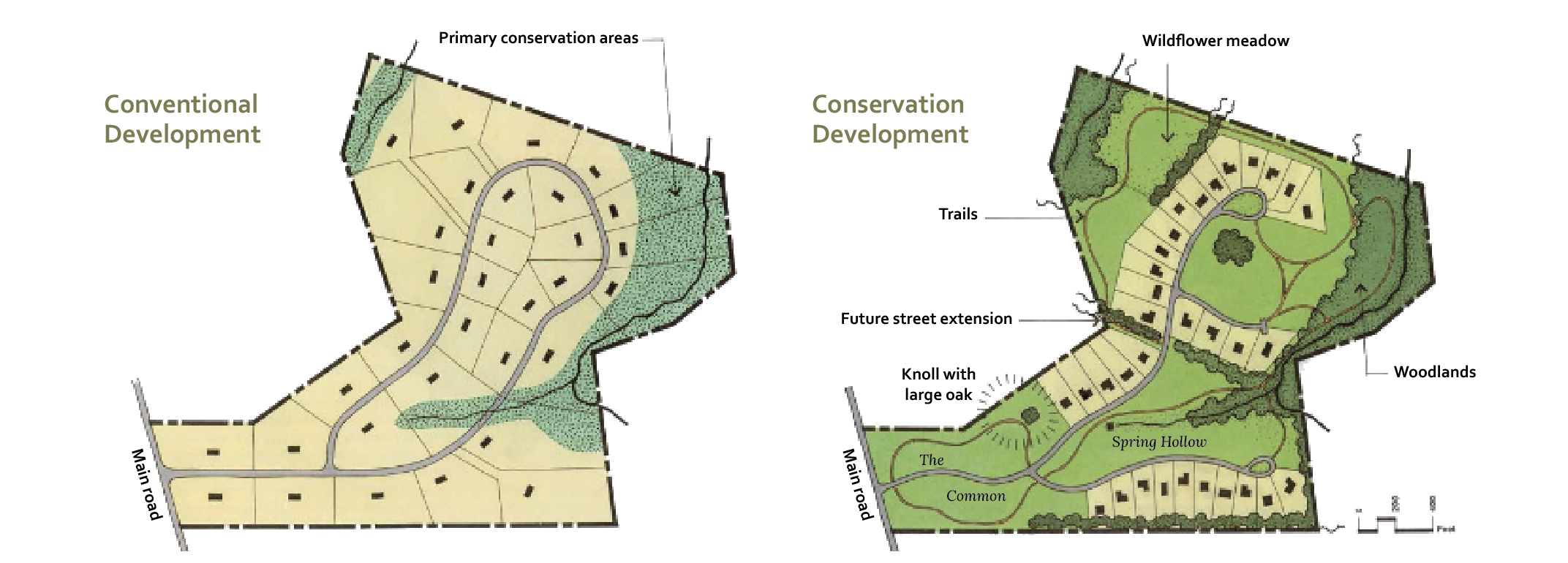
Conservation development — also sometimes referred to as open space residential development or cluster development — is a planning approach that groups homes together on smaller lots to preserve large portions of land as permanent open space. In a rapidly growing region, conservation development is one approach that balances the need for additional housing with the need for preserving meaningful amounts of open space.
While conventional lot-by-lot subdivision patterns often result in fragmented open space, conservation development at its best provides a connected network of amenity-rich open space (think walking trails, picnic areas, or recreational green space). Conservation development also typically results in more efficient use of infrastructure since clustering homes together reduces the number of roads and pavement needed to serve development.
It is worth noting that open space also directly benefits the community. One of the most important benefits of open space,
especially in a residential context, is its social value by providing neighbors with opportunities for frequent social interaction and engagement. Open space also helps protect community character by preserving the natural features that shape local identity such as woodlands, pastures, and wetlands.
Conservation development may look different based on whether it is situated in an urban, suburban, or rural context. For example, conservation development in rural areas may have higher requirements for open space preservation (e.g., mandating open space preservation of 50-60% of the buildable area). On the other hand, conservation development in more suburban or urban contexts may have slightly lower requirements for open space and allow for a diversity of housing types.
Many counties and cities across the Upstate are working to update standards for conservation subdivisions and open space residential development. Throughout this process, Upstate Forever has been engaged in advocacy efforts to ensure regulations preserve ample community open space while still remaining a viable option for developers. Since conservation development is rarely mandated, it is important to find the right threshold that achieves open space goals and ensures developer uptake.
Interested in learning more about important community planning and policy processes? Join our Land Planning & Policy email lists at upstateforever.org/email.
Allie Martinsen is the Land Policy Manager for Upstate Forever. You can email her at amartinsen@upstateforever.org.
Greenville, SC
507 Pettigru Street
Greenville, SC 29601
Spartanburg, SC
900 S. Pine St, Ste 1B
Spartanburg, SC 29302